Case Study: Diamond Jewelry Store
March 19, 2026 Case Studies
--> Get a FREE Growth Audit of your Amazon Store
Case Study: How a Diamond Jewelry Store Scaled from $7,000 to $100,000/Month on Amazon
In 2016, a Vancouver-based diamond jewelry retailer partnered with AMZing Marketing Agency with a clear goal: break into Amazon and turn it into a meaningful revenue channel.
On the surface, the business had strong fundamentals—premium craftsmanship, authentic diamonds (including GIA-certified pieces), and unique designs.
A High-End Brand Enters a Volume-Driven Marketplace
But Amazon is not a traditional retail environment. What works in a boutique showroom often fails in a fast-moving, algorithm-driven marketplace.
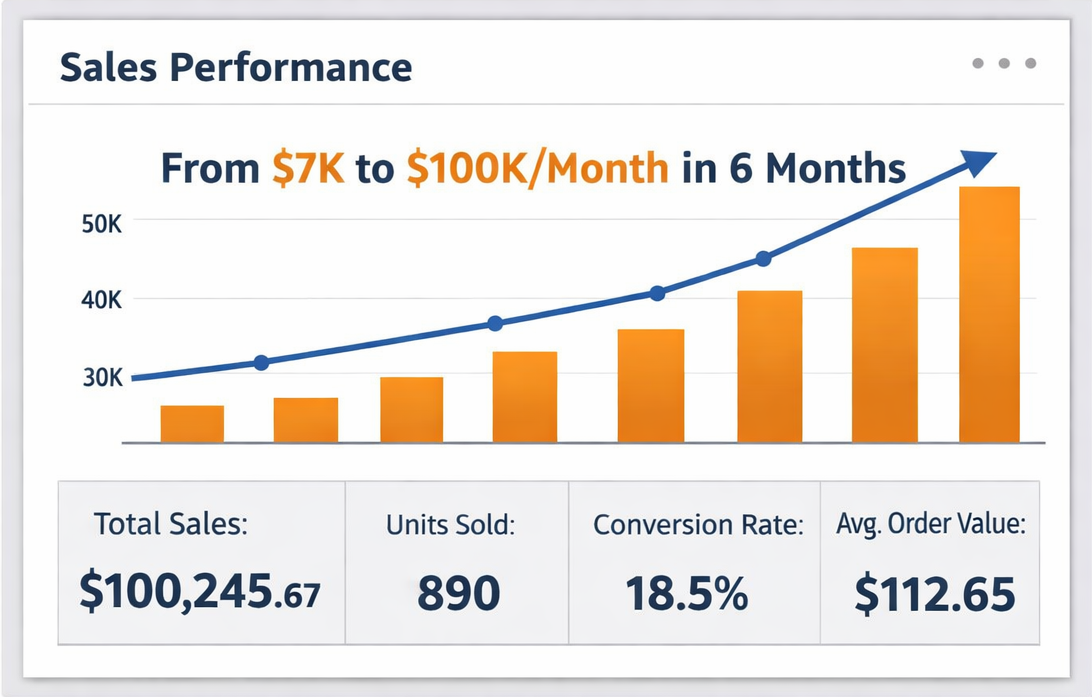
The result? Despite having over 80 products listed, the store was generating only $7,000/month in Amazon sales.
The owner has over 50 employees across different retail stores, but none of his staff was able to to increase the sales on Amazon due to lack of expertise and experience.
The frustrated owner eventually approached AMZing Marketing Agency for help.
Within 6 months, AMZing Marktinge Agency was able to grew the number grew to $100,000/month.
This case study breaks down exactly how that transformation happened.
Top 5 Core Challenges Identified by AMZing Marketing
1. High Ticket Products with Low Conversion
Many products were priced above $1,000, especially GIA-certified diamonds. While these items carry prestige, they face major friction on Amazon:
· Customers are hesitant to spend $1,000+ without strong brand trust
· Listings lacked social proof (few reviews)
· Jewelry is a highly visual category—poor presentation kills conversions
Problem: High price + low trust = extremely low conversion rate.
2. Limited Inventory on Unique Designs
Some pieces had only 1–2 units in stock due to their exclusivity.
While scarcity works in luxury retail, it’s a major disadvantage on Amazon.
Here’s why:
· Amazon’s algorithm prioritizes sales velocity (consistent sales over time)
· Selling 1 unit quickly → then going out of stock → kills momentum
· Once out of stock, rankings drop dramatically
· When restocked, the product must “restart” from near zero
In simple terms:
You cannot build ranking if your product disappears after a single sale.
3. Weak Listings (No A+ Content, Poor Images)
The listings had:
· No A+ content (no brand storytelling, no enhanced visuals)
· Basic or low-quality product images
· Minimal differentiation from competitors
In jewelry, perception is everything. If your listing doesn’t look premium, customers assume the product isn’t either.
4. Lack of Reviews
Most listings had fewer than 10 reviews, which is a major trust barrier.
On Amazon:
· Products with 20–50+ reviews convert significantly better
· Reviews act as social proof and reduce perceived risk
· Especially critical for jewelry, where buyers worry about authenticity
5. Not Using Fulfillment by Amazon (FBA)
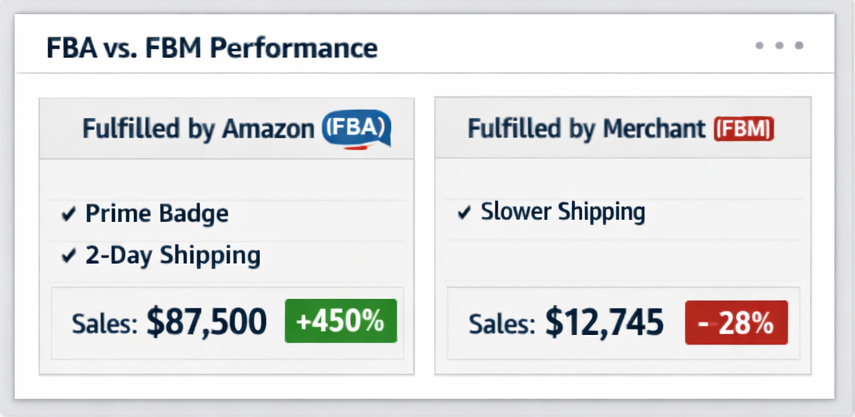
The store used Fulfilled by Merchant (FBM), which created several disadvantages:
· Slower shipping times
· No Prime badge
· Lower conversion rates
· Reduced Buy Box competitiveness
In contrast, FBA listings benefit from:
· Prime eligibility
· Faster delivery
· Higher trust
· Better ranking signals
The Strategic Shift Proposed by AMZing
AMZing Marketing identified a key insight:
“You don’t scale Amazon with high-ticket, low-volume products first. You scale with high-velocity products—and then lift your premium catalog.”
Step 1: Introduce a Sub-$200 Product Strategy
We advised the client to focus on:
· Diamond jewelry priced below $200
· Products with at least 20 units in inventory
· Designs that could be replenished consistently
This created a foundation for:
· Faster sales velocity
· More reviews
· Better ranking potential
Step 2: Transition to FBA
Selected products were sent to Amazon FBA warehouses.
Impact:
· Prime badge increased click-through rate
· Faster delivery improved conversion
· Amazon favored FBA listings in search results
Step 3: Upgrade Visual Assets
We completely revamped product presentation:
· Professional high-resolution images
· Lifestyle shots (models wearing jewelry)
· Close-up diamond clarity visuals
· Clean white backgrounds for compliance
Why this matters:
Jewelry is an emotional purchase. Customers need to see quality before they believe it.
Step 4: Build A+ Content with Brand Storytelling
We created A+ content that included:
· Brand story (craftsmanship, authenticity, heritage)
· Diamond education (clarity, cut, certification)
· Comparison charts
· Lifestyle imagery
This transformed listings from “commodity products” into brand experiences.
Step 5:
Step 6:
Why Selling One Piece at a Time Fails on Amazon
This was one of the most critical education points for the client.
The Sales Velocity Problem
Amazon’s algorithm rewards:
· Consistent daily sales
· Stable inventory
· Conversion rate
If you sell 1 unit and go out of stock:
· Your ranking drops
· Competitors replace you
· Your product loses visibility
The “Reset Effect”
When inventory returns:
· You don’t resume your old ranking
· You must rebuild momentum
· Advertising costs increase again
The Compounding Effect
High-performing listings benefit from:
· More visibility → more sales → better ranking → even more visibility
Low-stock products break this cycle entirely.
Additional Solutions Implemented
Results After 6 Months
Revenue Growth
· From $7,000/month → $100,000/month
This was driven primarily by:
· High-velocity SKUs
· Improved conversion rates
· Increased organic ranking
Review Growth
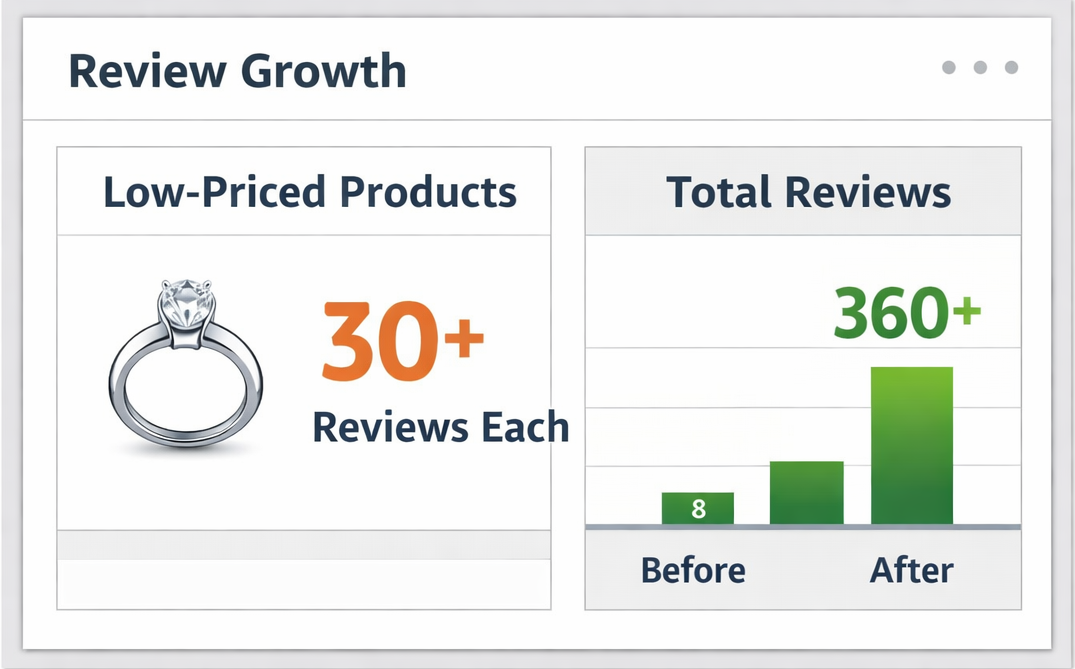
· All targeted low-priced listings reached 30+ reviews
· Some exceeded 50+ reviews
This created:
· Strong social proof
· Higher trust
· Better conversion rates
Conversion Rate Improvement
Listings improved significantly due to:
· Better images
· A+ content
· FBA fulfillment
Organic Ranking Gains
Products began ranking for:
· “diamond earrings”
· “diamond studs under 200”
· “affordable diamond jewelry”
This reduced reliance on paid ads over time.
Selling Jewelry on Amazon Canada: Key Insights
Selling jewelry on Amazon in Canada presents unique dynamics:
1. Smaller Market, Less Competition
Compared to the U.S.:
· Lower competition
· Easier to rank
· Faster market penetration
2. Trust Is Even More Important
Canadian buyers are cautious with:
· High-value purchases
· Unknown brands
This makes:
· Reviews
· A+ content
· Professional images
even more critical.
3. Logistics Advantage with FBA
Using FBA in Canada:
· Ensures nationwide delivery (including remote regions)
· Improves customer experience
· Increases Buy Box win rate
4. Price Sensitivity
Canadian consumers are:
· More value-conscious
· Responsive to deals under $200
This aligned perfectly with the strategy.
The Bigger Strategic Insight
Find out what is stopping your Amazon sales from growing.
Meet Our Amazon Experts
AMZing Marketing Agency (Canada) helps Amazon sellers improve listings, PPC campaigns, SEO ranking, fix listing issues, and sales growth.
✓ 2,900+ Sales Generating Product Listings Created
✓ 5,700+ Advertising Campaigns Optimized
✓ Helping Amazon Sellers Since 2013
Schedule a Free ConsultationWhy Amazon Sellers Choose AMZing
✓ Amazon SEO & Listing Optimization
✓ Amazon PPC Advertising Management
✓ Account Health & Compliance Support
✓ FBA Planning & Marketplace Growth Strategy
Contact AMZing MarketingPopular Amazon Seller Resources
- Plugin Bludit: Demo of Meta Title and Meta Description
- Amazon AWD Explained: The Ultimate Guide to Replenishing FBA Inventory (Avoid Costly Mistakes & Scale Faster in 2026
- How to move AWD inventory to FBA and Fix Errors Auto-Replenishments to FBA
- Ultimate Guide To Selling Supplements On Amazon -> What NOT to Do
- Case Study: Diamond Jewelry Store
- Why Allowing Third-Party Sellers on Your Amazon Product Listings Can Damage Your Brand
- Amazon Sales Dropped After Restock? Why You Need Aggressive PPC Relaunch To Restores Sales Velocity Fast
- Amazon Listing Hijacking Between Manufacturers and Resellers: Why It Happens and How to Solve It